Claims processed to date:12,960,971

Debridement and skin substitute denials are recoverable

Wound care sits inside podiatry, plastic surgery, orthopedic, and hospital outpatient programs, and payers check measurements, depth, and visit frequency in all of them. In 2026 Medicare moved most skin substitutes to a single supply payment per square centimeter and changed the wastage rules that went with it. Ember reviews every encounter and works every denial.
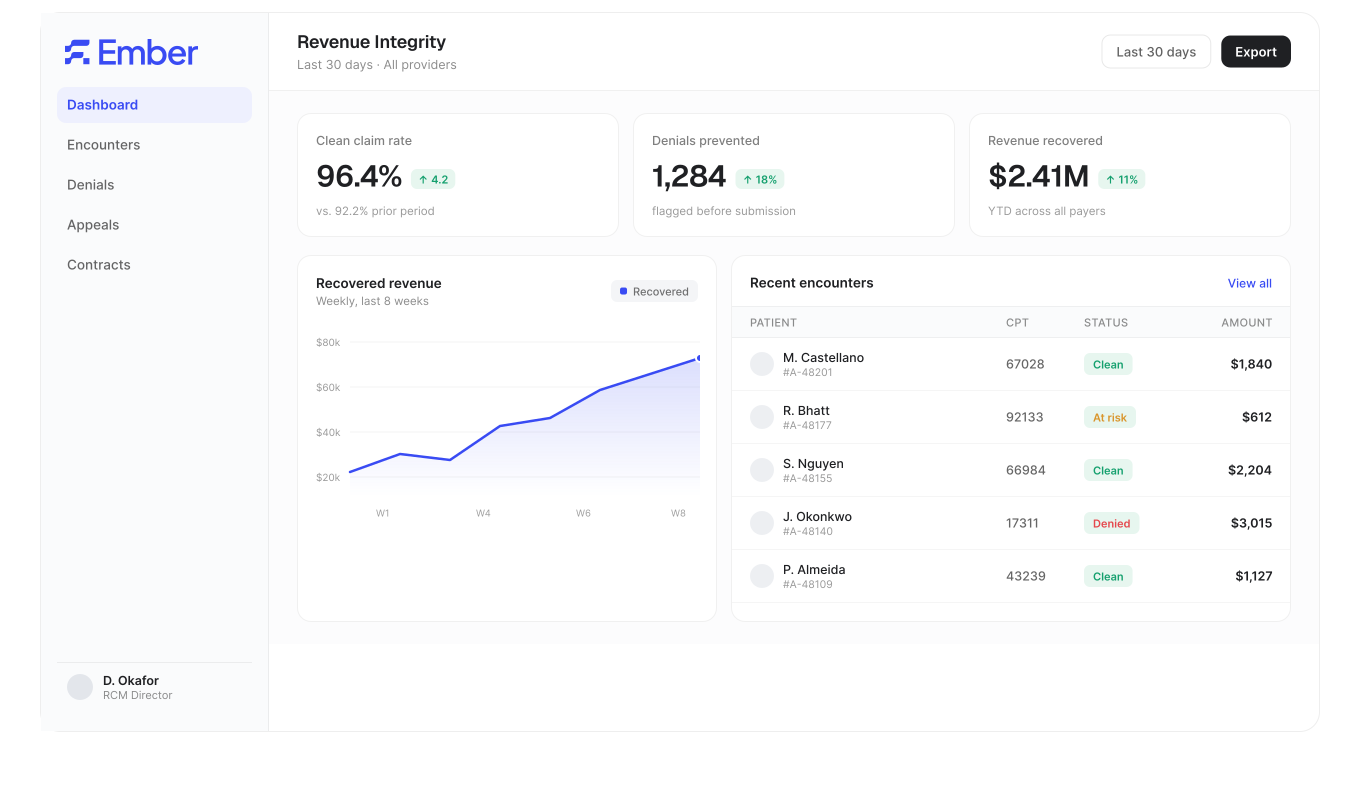
Ember revenue integrity dashboard

2,700+ providers across 40+ states trust Ember AI

Where wound care revenue leaks

Top wound care denials Ember resolves

Ember addresses the recurring coding, documentation, frequency, and authorization issues that delay or reduce payment for wound care.

01 · Debridement coding

Debridement underpays or denies when depth and surface area don't match the note

Debridement codes are chosen by the deepest tissue removed and billed by total surface area at each depth. Ember checks the documented depth, measurements, and tissue removed against the codes and units before the claim goes out.

11042-11047 · 97597-97598

02 · Skin substitutes

Skin substitute claims deny on wound size, product units, and modifiers

Application codes depend on wound size and location. The note has to name the product with its serial or lot number and the units applied and discarded, and Medicare no longer accepts JW or JZ on supply-billed products. Ember checks the application code, units, and product documentation against the wound record and each payer's rules.

15271-15278 · Product units applied

03 · Medical necessity

Ongoing wound care denies when the chart doesn't show progress

Payers expect measurements at every visit, a documented plan of care, and evidence the wound is responding before they keep paying for debridement, compression, or grafts. An auditor reads the note you billed, so four weeks of measurements in earlier visits don't help if today's note doesn't carry them forward. Ember flags notes missing the measurement history or progress the payer requires before submission and assembles the wound history when an appeal is needed.

Wound measurements · Plan of care

Three engines.
One source of truth.

Ember connects clinical documentation, payer policy, and contract terms into a single intelligence layer, built for the measurement-driven coding and repeat visits wound care billing requires.

D. Brooks

Encounter #W-20519

Unified
Documentation
Right heel DFU, 6.2 sq cm, to subcutaneous tissue
Coding
11042E11.621L97.412
Payer policy
Payer · Wound care and debridement
Contract
Rate §2.4

01 · Foundation

Data Engine

Bridges the clinical and the financial. Unifies documentation, coding decisions, payer policy, and contracts across every debridement, graft application, and follow-up visit.

Audit#W-20519
11043Debridement, muscle, first 20 sq cm
Pass
+11046Each additional 20 sq cm
Pass
Q-code96 units, lot number missing
Flag

Document product lot number and units discarded

Product documentation rules · confidence 0.95

02 · Audit

Coding Engine

Reviews 100% of encounters against national standards, payer-specific policies, your internal guidelines, and your payer contracts. Apply LCD rules to Medicare only or to every payer, and add your own guidelines as you go. Every flag carries a rule citation.

Re: Claim #W-20519 · Denial CO-50

The denied serial debridement meets medical-necessity criteria documented in the weekly wound measurements showing a reduction in ulcer area and is reimbursable per contract §2.4…

Denial received
Appeal drafted
Submitted · in review
Adjudication pending

03 · Recovery

Appeal Engine

Reads CARC and RARC codes, identifies the applicable LCD/NCD policy and contract terms, drafts the appeal letter, packages documentation, and tracks every claim to adjudication.

Audit upstream.
Appeal downstream.

Two workflows do most of the work for wound care programs. The first prevents denials before they happen. The second recovers the ones that slip through.

Catch the measurement gap before the claim leaves

Ember reviews every encounter against coding standards, payer policy, and your contracts. Depth and surface area errors, skin substitute unit and modifier issues, and missing progress notes are flagged before submission.

  • 1

    Ingest the encounter

    Pulls clinical notes, procedure codes, and modifiers from Epic, athenahealth, and your PM system.

  • 2

    Validate against rules

    Checks debridement depth and area, skin substitute units, and visit frequency against payer policy and your contracts.

  • 3

    Recommend with citation

    Returns the suggested correction tied to the exact payer policy, LCD/NCD reference, or appropriate-use criteria.

  • 4

    Educate the provider

    Coding patterns drive provider-level coaching, so documentation and modifier accuracy improve across every site.

Encounter review#W-20519
97597Selective debridement, wound 1
Pass
29581Multilayer compression, below knee
Pass
11042Wound 2, depth not documented
Flag

Document deepest tissue removed to support 11042

CPT debridement guidelines · confidence 0.94

Clean-claim rate
+23%
Encounters reviewed
100%
Net collection rate
+5%

Pull. Review. Push.

When a denial occurs, Ember identifies the root cause, retrieves records, references payer policy and contract terms, drafts the appeal, and tracks it through adjudication.

Pull12
CO-197

Auth not on file

CO-16

Missing wound measurements

Review7
CO-50

Medical necessity

Push9
CO-151

Frequency exceeded

Learn—
PAID

Serial debridement appeal

Denial rate
-57%
Cost to collect
-45%
Net revenue per appt
+9.3%

The full revenue cycle

From eligibility to adjudication. Covered.

Audit and appeals are the workhorses, but Ember protects wound care revenue at every stage of the cycle.

Eligibility Verification

Confirms coverage, benefits, and site of service before treatment starts, and keeps proof of every check, a portal time stamp or the rep name, reference number, and call time.

Prior Authorization

Checks auth requirements in real time for skin substitutes, hyperbaric oxygen, and negative pressure wound therapy, gathers the wound history, and submits to payer portals automatically.

AI Medical Coding

Reviews 100% of encounters, debridement depth and area, skin substitute applications and units, and compression, against national standards, payer rules, and the product list your practice bills.

Pre-bill Audit

Predicts and prevents denials before claims go out, catching depth and area errors, unit mismatches, and visits missing measurements.

Denial Management

Full appeal lifecycle for every wound care denial type, auth failure, medical necessity, frequency limit, and coding error, tracked to adjudication.

Underpayment Recovery

Parses contracts to model what each debridement and graft claim should pay, then surfaces line-item underpayments at scale.

High-volume wound care revenue, recovered

-57%

denial rate

-45%

cost to collect

100%

encounters audited

7 days

to first results

Based on Ember AI benchmarks across customer practices. Results vary by payer mix and specialty.

Revenue leaders, on the record

What specialty practices and health systems say after putting Ember into production.

“Ember delivered exactly what they promised, and they keep delivering. Providers are able to fit Ember into their daily workflow without it feeling heavy or complicated.”

Katie Greiner

VP of Physician Engagement, Midwest Vision Partners

Missed revenue uncovered
$1M+
Encounters reviewed
200K+
From deployment
3 months
“We looked at a number of AI partners, but Ember stood out because it could identify opportunities for accuracy improvement in our coding and documentation that we might otherwise miss. Ember helps us understand what's missing and why it matters, so we can strengthen our documentation, make our charts more precise and address issues before they impact revenue.”

Kashonna Morrison

VP of Revenue Cycle, Elevate ENT Partners

“Denials can become a significant drain on our team's time, especially when there's a large volume of cases to work through. Ember helps us work through that volume more efficiently and prioritize the cases that need attention. It means our team can spend less time on manual follow-up and more time getting claims resolved.”

Samantha Martin

RCM Billing Manager, Direct Orthopedic Care

“At Bone and Joint Institute of Tennessee, one of my biggest priorities as CEO is ensuring we receive appropriate reimbursement for the care we deliver without administrative costs rising at the same pace as patient volume. Ember AI has helped us reduce our surgical coding costs by 80% while maintaining accuracy, and providing a clear root cause and resolution path for 100% of claims reviewed. This gives our team actionable insights to resolve denials more efficiently.”

John B. Reynolds

CEO, Bone and Joint Institute of Tennessee

“One of the biggest challenges in revenue cycle management is having the visibility to understand where revenue opportunities exist and where reimbursement may be falling short. Having better data and insights allows us to be more proactive, make informed decisions, and identify opportunities to strengthen our financial performance.”

Catherine Roman

Senior Director, Platinum Dermatology Partners

Frequently asked questions

Everything you need to know about how Ember fits into your revenue cycle.

Yes. Ember AI connects seamlessly with all major EHRs and PMS platforms, including Epic, Oracle Cerner, athenahealth, and eClinicalWorks, as well as payer portals. Our standards-based integrations automate prior authorization, eligibility verification, and claims submission, allowing you to preserve existing infrastructure while modernizing the revenue cycle.

See what your wound care program is leaving on the table

Bring us 30 days of denial data. We'll show you where the revenue is and exactly how Ember would recover it.